No tool can promise rankings or AI citations. Rankara tells you which problems are documented to matter, gives you the fix for your framework, and shows what changed in Search Console after you shipped it.
Up to 50 pages, every week, every finding labelled
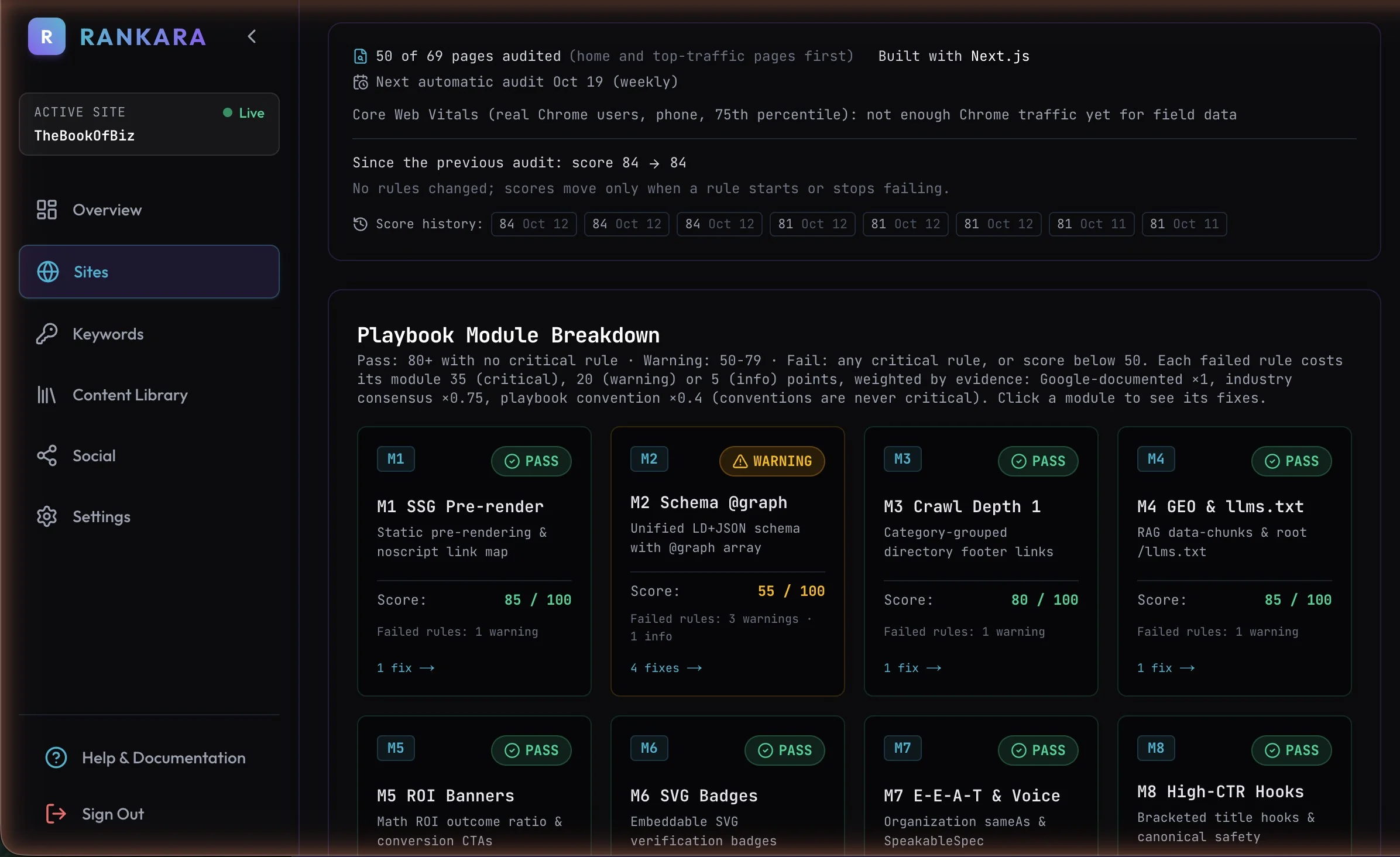
Each audit fetches your home page, then the pages with the most Search Console impressions, then the sitemap, up to 50 pages. It detects the framework (Next.js, Nuxt, Astro, WordPress, Laravel, Vite and others), follows redirects instead of scoring the destination under the old URL, and re-runs automatically every week.
8 modules, scored from what Google documents down to playbook conventions (table below)
Sites that render their content only with JavaScript are capped at 40, whatever else they get right
Each audit is compared with the last: what was fixed, what's new, and what you marked fixed but still fails
Core Web Vitals from real Chrome users (Chrome UX Report) once a site has enough traffic
02 FIX CARDS & PROMPTS
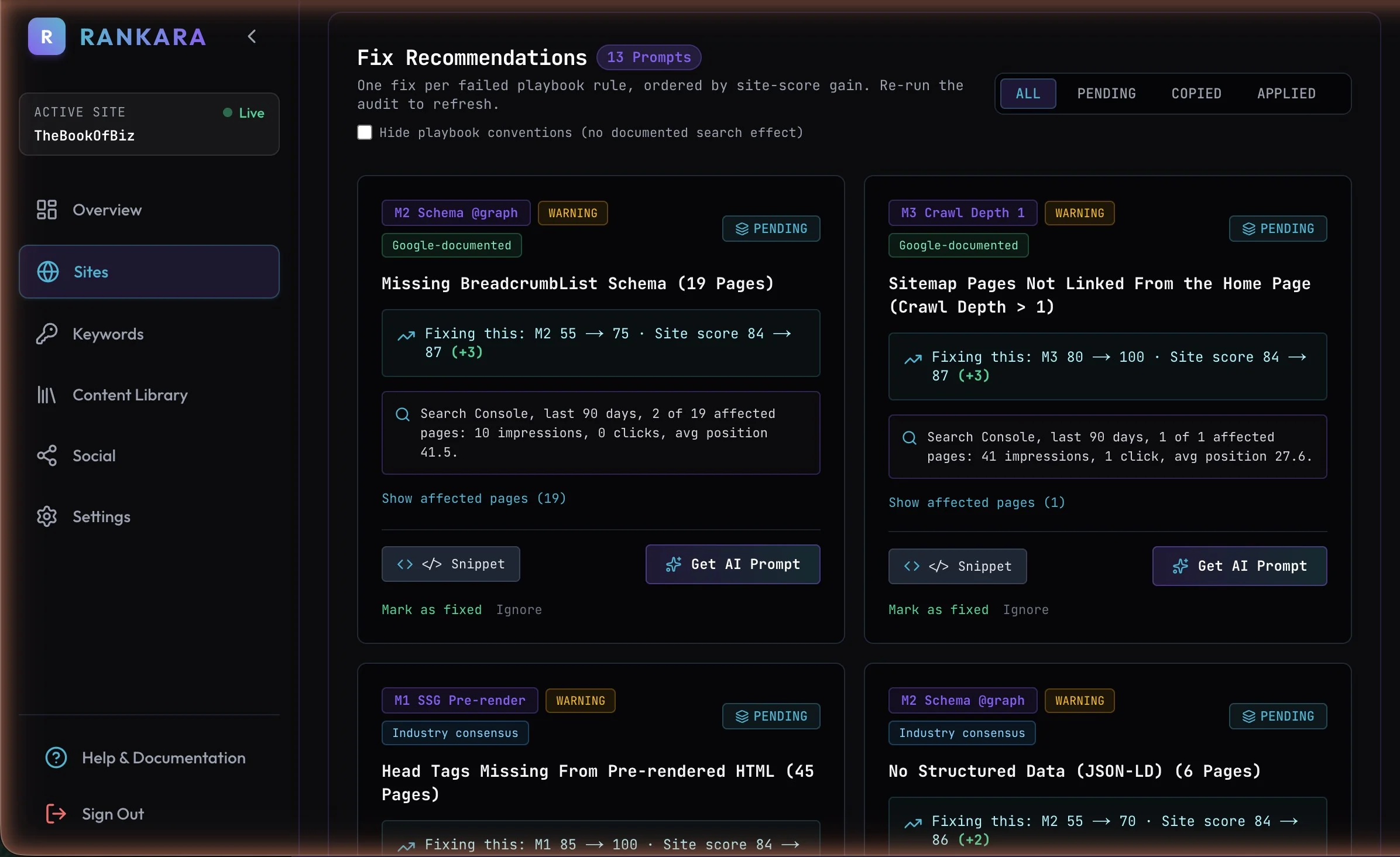
One card per problem, with the fix for your stack
Every failed rule becomes a card ordered by how much fixing it raises the score. A card shows which pages are affected, their Search Console clicks and impressions, a code snippet, and an AI prompt written for your framework that you paste into any assistant.
Mark a card fixed: the next audit verifies it, and flags it if it still fails
Ignore a card, or hide playbook conventions entirely
Click a module to see only its cards
03 QUERY COVERAGE
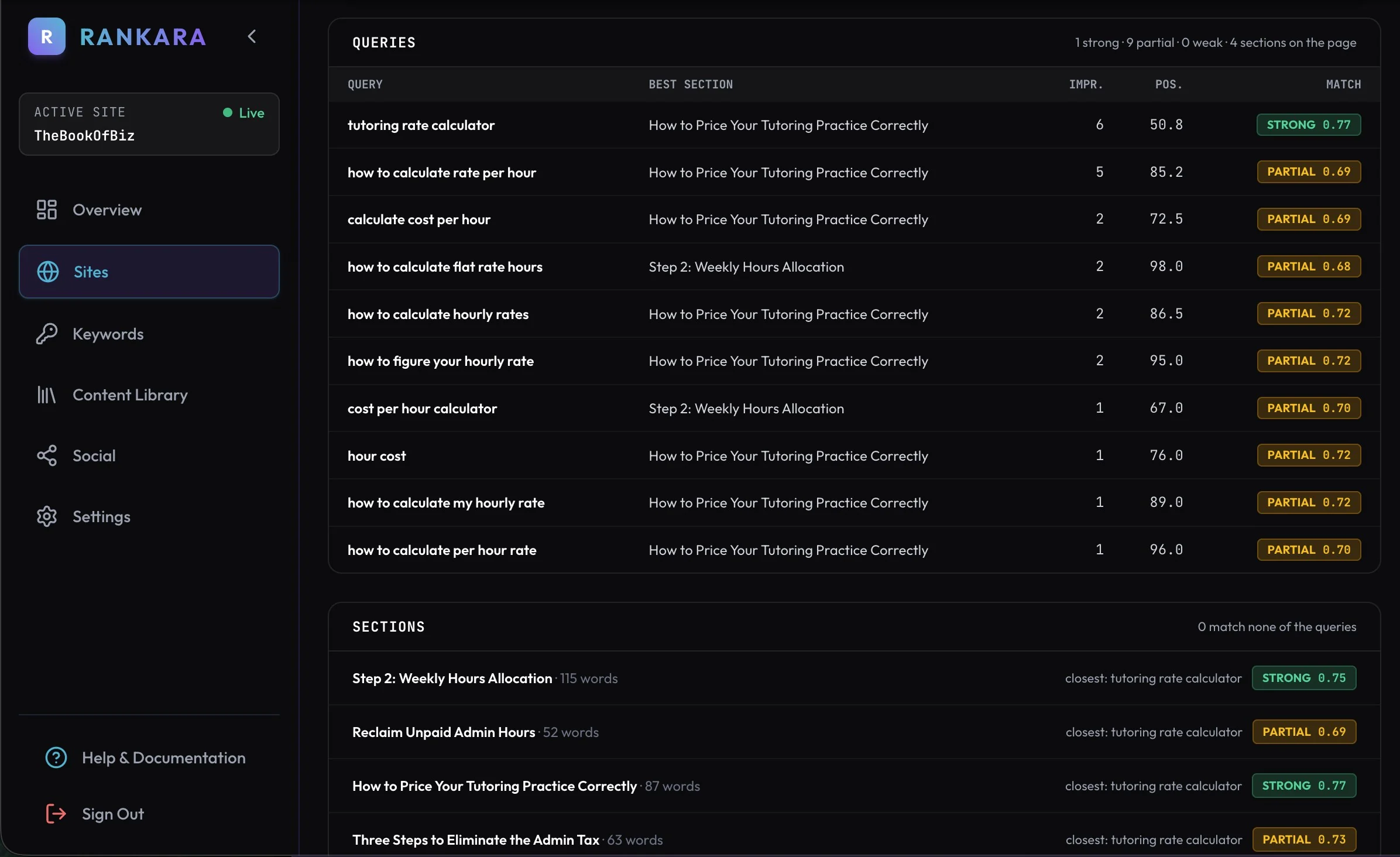
The queries your pages rank for but don't answer
Google already shows your pages for queries at positions 5 to 20. Rankara splits each page into its sections and scores every section against those queries with Gemini retrieval embeddings, so you see which section answers each query and which queries nothing on the page answers.
Gaps ranked by impressions across the site; brand searches and retired URLs left out
A rewrite prompt for the closest section, a new-section prompt that fits the page outline, or an article brief
Test a draft against the same queries before you publish it
Cutoffs calibrated on real pages: 0.75+ strong, 0.65-0.75 partial, below 0.65 weak
04 BEFORE & AFTER
Did the fix move the query?
When you mark a gap fixed, Rankara records that query's Search Console numbers for the page over the previous 28 days. Every day after, it compares them with up to 28 days after the fix (skipping 3 days while Google recrawls), next to your whole site's trend over the same days, because a sitewide swing moves every query.
Verdicts: improved, declined (1.5 positions or more), no clear change, or not enough data yet
No verdict before 14 days of data or with under 10 impressions on either side
Undo a fix if it wasn't one after all
05 CONTENT & TEAMS
Briefs and access for your team
AI Brief Studio (Pro and Agency): title, intent, outline, related terms, FAQs and internal links to your published pages
Owner, admin, member and viewer roles; Agency viewers can be limited to specific client sites
Search Console connects read-only through Google sign-in; credentials are encrypted at rest (AES-256-GCM)
What the audit checks
Every finding is labelled by how well-evidenced it is, and the score weights it accordingly.
Google-documented×1.0
Google's Search Central documentation describes the requirement (canonicals, sitemaps, robots.txt, structured data, Core Web Vitals).
Industry consensus×0.75
Widely agreed best practice without a documented ranking effect (breadcrumbs everywhere, internal linking depth).
Playbook convention×0.4
Rankara's AI-search playbook, not documented by any engine (title hooks, /llms.txt, data-chunk tags). Never fails a module on its own.
Module
What it checks
M1 Pre-rendering & Head Tags
Content that only appears after JavaScript runs, one H1, title/description/Open Graph tags in the server HTML, Core Web Vitals from real Chrome users.
M2 Schema.org @graph
JSON-LD present and in an @graph with @id on each node, Organization markup for the site, BreadcrumbList on inner pages.
M3 Crawl Depth & Sitemap
A valid sitemap with lastmod, sitemap entries that redirect, pages linked from the home page, keyword cannibalization from Search Console.
M4 GEO: llms.txt & AI Bots
robots.txt access for GPTBot, ClaudeBot, PerplexityBot and Google-Extended; /llms.txt and /llms-full.txt; Q&A blocks and tagged sections.
M5 ROI Framing & CTAs
A clear call to action on each page and outcome-versus-cost framing somewhere on the site.
M6 Backlink Badges
An embeddable badge or snippet other sites can link back with.
M7 E-E-A-T Entities
Organization sameAs links and knowsAbout topics where the brand is declared; speakable markup.
M8 SERP Hooks & Canonicals
Title and meta description length, title hooks, canonical tags (missing, pointing elsewhere, or not matching the sitemap), HTTPS and www redirects, live duplicate URL variants.
What Rankara is
An audit and measurement tool for the sites you own
Built on your Search Console data and your pages' real HTML
Honest about evidence: conventions are labelled as conventions
What it isn't (yet)
A backlink database or keyword-volume tool: there's no third-party search volume
A rank tracker for queries you don't appear for in Search Console
An AI citation tracker (on the roadmap)
Start with a free check of your home page
AI crawler access, /llms.txt, sitemap, structured data, rendering and titles. No sign-up.